Maths, Mitigation and Materials
Dr. Richard O’Hegarty
Embodied carbon is no longer a niche topic. We’ve all heard of it, we all know it’s important, but how well do we understand it? And is this understanding enough to meet the requirements of increasingly stringent legislation?
The EU is mandating embodied carbon disclosure for large buildings from 2028, and for all buildings from 2030 [1]. With embodied carbon limits to follow. This shift from something voluntary, to something mandatory raises the bar for our industries’ acceptable level of collective understanding.
To arrive at this quantum of understanding, upskilling is needed throughout the construction industry. With that in mind, and with a hope to limit some potentially hard lessons, here are three warning signs to watch out for when tackling embodied carbon:
– The maths is “easy”.
– The mitigation impacts are long-term and dispersed.
– The materials are complex.
Quick recap
For anyone new to the subject, embodied carbon is the term widely used in the construction sector to describe the carbon dioxide (and other greenhouse gas) emissions resulting from the production, transport, construction, maintenance and demolition of building. You might also hear the term “embodied – lifecycle global warming potential” but that’s a bit of a mouthful so let’s go with embodied carbon from here on. It’s not perfect, but nor are many well-established terms and words we use today. There are hundreds of articles describing embodied carbon at this stage. This article is not another one of those, so below is a sketched recap instead and here is an older article on the topic.
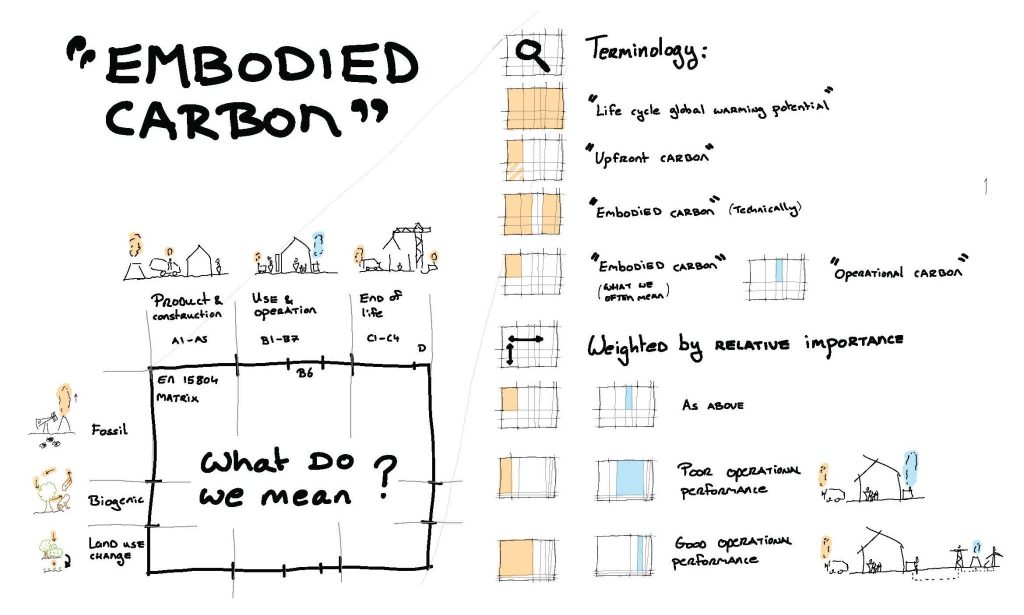
Figure 1. What do we mean by “embodied carbon”
Warning #1 – The maths is easy
The reason easy maths is an issue, is two-fold:
– Easy maths does not mean an easy problem.
– Easy maths = boring = reduced cognitive defences = more errors.
Beginning with the first issue (easy maths ≠ an easy problem), there is a risk that we assume the spreadsheet-style calculations don’t warrant training, upskilling or understanding. That a piece of software could be developed to serve as the silver bullet the industry needs to meet all demands from emerging legislative. But while the maths might be simple the underlying assumptions at every decision point requires a good understanding of both construction and environmental impacts. The simplicity of the maths can trick us into assuming a simple problem exists, where it doesn’t. If it were so simple we’d all agree how much embodied carbon is in an “average” building. We still don’t. Partly because “average” doesn’t mean a whole lot when it comes to the inherent heterogeneity of our built environment, but also because our methodologies and industry-wide skills aren’t fully mature and certainly aren’t aligned.
The outputs of a model are only valuable when accompanied by a certain level of understanding, and when originating from quality inputs. The solution to this easy- maths challenge is to simply respect that the problem is not simple. Train yourself. Get trained. Read. Study. Ask questions.
The second part of the simple-maths issue (#2 boring maths = reduced cognitive defences) is more of a human challenge. The simple mechanics of the maths means that we can get away with carrying out the operation easily. If the maths is cognitively challenging, we need to engage the “slow thinking” part of our brain to get a result (I’ll refer to you Daniel Kaeinhman’s Thinking Fast and Slow for the details [2]. But in summary, you can’t do differential calculus while on a call, reading emails or in a meeting. But you can input some figures into a spreadsheet or a tool without much thought and get an-output. Given this ease-of-operation, our cognitive defences aren’t there to protect us from mistakes. The fancy graph looks good enough, and its Friday evening. Good enough will do.
For this cognitive issue, solutions do exist. We can train our mental discipline and try to improve our ability to focus. I think this is a worthy endeavour in general and practice it myself. I use electronic music to try and engage this state of focus. It works sometimes, and I consider myself pretty good at being able to focus. But let’s be honest, the digital world is designed to distract us. This solution swims against the relentless current of distractions – emails, calls, Teams messages, social media, the web browser we had to open to check out an EPD, the fly on the wall.
Enhancing our focus is important but we need something else. That something else is a benchmark. An expected range of values where our analysis may land. More pertinently, we need multiple benchmarks for individual components, materials and groups of components and materials. We can then use such benchmarks in our workflows to stress test our progressive output. And this doesn’t mean that your answer can’t be out of range. You just need to understand why it might be. It is also upon this constant de- and re-construction of the data that we can accrue valuable insights.
There has been some progress here, but we aren’t quite there yet. In the absence of this perfectly organised, globally comprehensive dataset we must engage in the process ourselves. Every output needs to be questioned and cross-checked, the use of EPDs needs to be compared, material quantities need to be thought about. And yes, this takes time, experience and cognitive effort.
Easy maths, in the absence of understanding, poses a risk. A risk that we get the wrong result but don’t know it, or know its wrong but don’t know why. Which leads us onto warning #2.
Warning #2 – The impact of mitigation is long-term, and dispersed
When you design a bridge, beam or fence, the consequences of getting the structural calculations wrong are very tangible. They are both physical and local. The bridge collapses, the beams crack, the fence falls. As a result, structural engineers apply safety factors.
If you carry out an embodied carbon calculation and get it wrong, the physical consequences are a mismatch between how we think we’ve contributed to climate mitigation and how much we actually have. This consequence is both global and long term. There is essentially no material accountability. Of course there is a risk of reputational damage to you and your organisation, but there isn’t a physical event we can point to as the consequence of our errors. We’ve “just” added more (or less) CO2 into the atmosphere than what our calculations tell us.
Because of the physical risk in structural design, engineers skew on the side of caution from the theoretical optimum using conservative safety factors. Embodied carbon calculations, on the other hand, in the absence of any tangible accountability, may skew on the side of over performance to meet an imposed limit value.
We therefore need both better rules, and better players. Like many things it’s not “either this or that”, it is “this and that”.
The likes of RICS [3] have developed a standard with considerable detail and probably the most comprehensive methodology out there. But even here there is scope for favourable assumptions and inputs. So, while we need to continue to enhance our methodologies, we need to also upskill and professionalise embodied carbon work.
One of the reasons why a perfect method is likely unattainable brings us to our third warning.
Warning #3 – Material are complex
While the maths used to conduct embodied carbon calculations is easy, the assumptions and inputs are anything but simple. In fact, it is this complexity, not the numbers, spreadsheets and standards, which personally attracts me to embodied carbon research. The former compliance matters are essential to getting this right, but it’s the latter which stimulates curiosity. To appreciate the nature of any material and where the embodied carbon figures have been derived from, I again promote reading. Ed Conway’s Material World [4] is a good start. It’s nothing to do with embodied carbon per se, but the narrative for each of the six material groups he covers leaves you feeling like you’ve entered a version of the Dunning-Kruger curve with an incredibly wide valley of ignorance. And that it’s quite pleasant to be there. To be humbled by the material world.
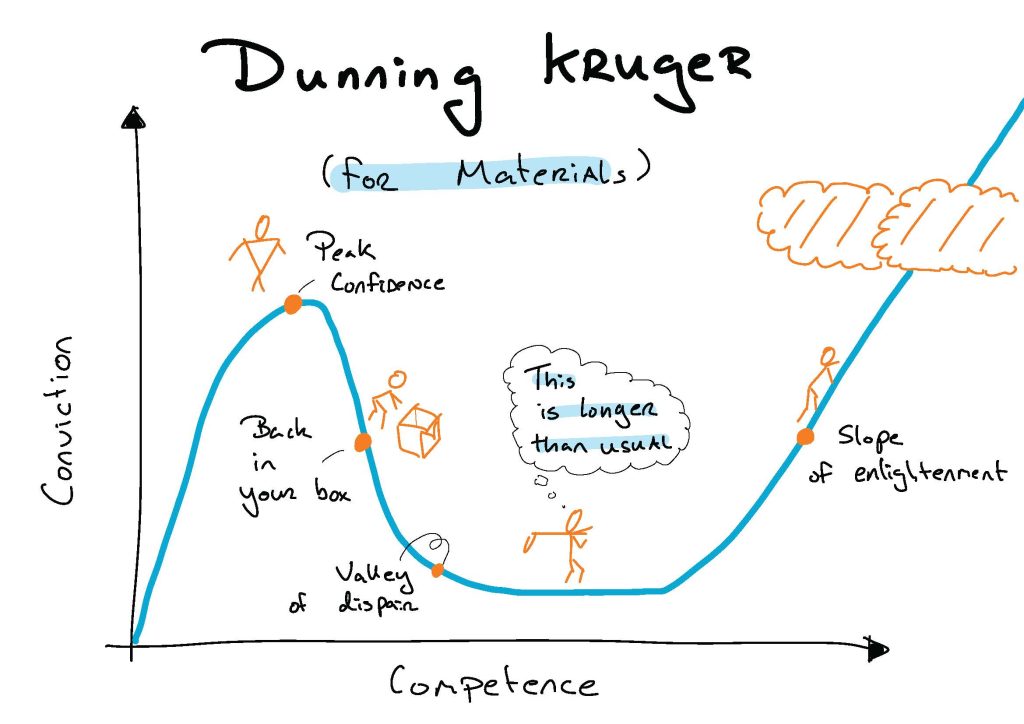
Figure 2. Dunning Kruger curve for materials
For buildings, we’ve the big three – steel, concrete and timber. There are several other key materials but this article is already long enough. All materials have a fascinating and complex story, meaning the values we input into our calculations will vary hugely depending on the assumptions made. One method I use to think about material’s carbon impact is to ask two questions:
Q1. what temperature does this stuff need to be produced at? and,
Q2. what other chemical process are at play?
And then of course we must appreciate that different materials do different things. Thermally and chemically intensive processes might be justified if that means the material becomes so good at doing the thing it needs to do, that we need much less of it. That is essentially what structural engineering is – using the right amount, of the right materials, for the right purpose.
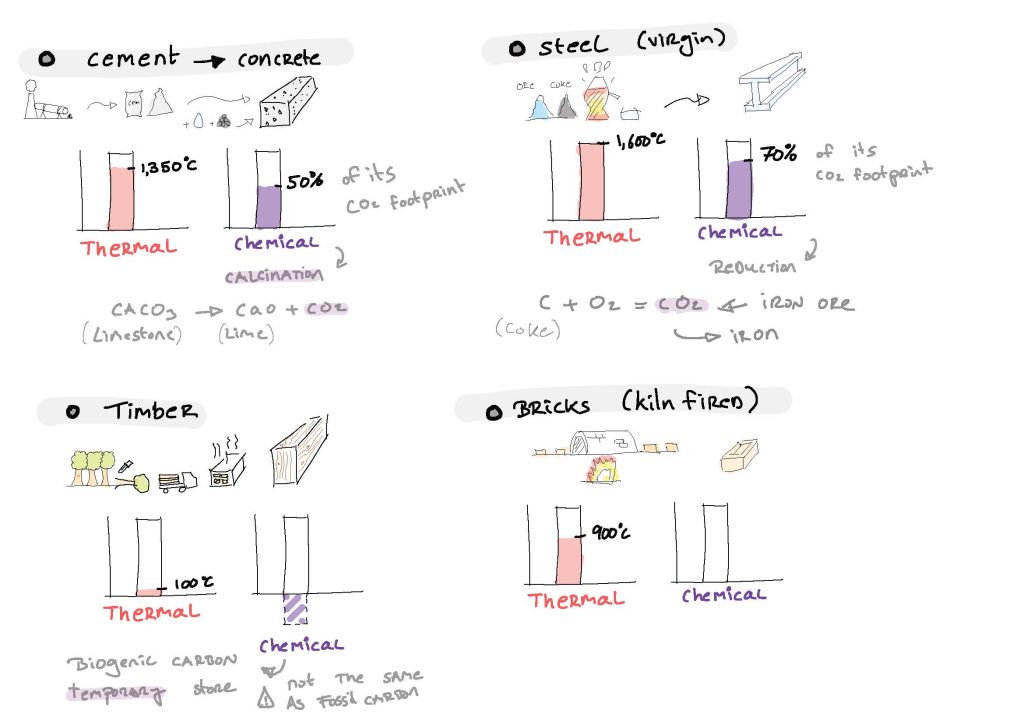
Figure 3. The thermal and chemical processes of materials. This is (obviously) conceptual but the numbers are approximately correct. The “steel” represents the iron making part of the process, as with the others there are several steps.
Take steel for example. The embodied carbon ranges from ~50 kgCO2/t for a reused steel beam[5] to above ~2500 kgCO2/t for steel derived from a virgin blast furnace and basic oxygen furnace[6]. This range is so vast that you can be orders of magnitude off the actual number if you don’t understand even the basics of steel.
Then take concrete, the most impactful material in the world, simply because it is the thing we use most of (after water). And we use so much of it because of its adaptability, flexibility, cost and its ease of use. Its inherent low cost is also why it is a material where there is often great scope for carbon reduction. The cost savings that aren’t picked up by a cost analysis, can be picked up by a carbon analysis. Although the variation in embodied carbon intensity of concrete (kgCO2/m3) is not as significant as steel, the volume of concrete used in a building is typically much greater, so smaller changes (or mistakes) compound. Tackling this includes finding out where most of the concrete is (usually floor slabs for larger buildings and foundations for smaller ones) and then focusing on reducing the amount of it, and the embodied carbon intensity of the mix designs.
Moving on to timber we have perhaps the most complex of all materials to measure from a carbon perspective. And possibly the most polarising. “Are you team-timber or not?” I feel I sometimes get asked as if the discussion should be trivialised down to a “yes” or “no”. It is also the most exceptional example of how assumptions in the absence of explanation can yield wildly different results. So wild that one assumption can change the embodied carbon impact of wood from having a global warming potential to having a global cooling potential. I’m a big believer in not mixing your metrics. Some LCA reporting frameworks require reporting a total carbon figure which means that the biogenic carbon gets mixed in with the fossil carbon (see figure 1). I don’t think this is correct. I think they are very different things and need separation. The research is not in agreement on broad stroke measures for dealing with biogenic carbon and most studies swing heavily depending on the assumptions made about timber (and other biobased material)’s source, service life and end of life scenario.
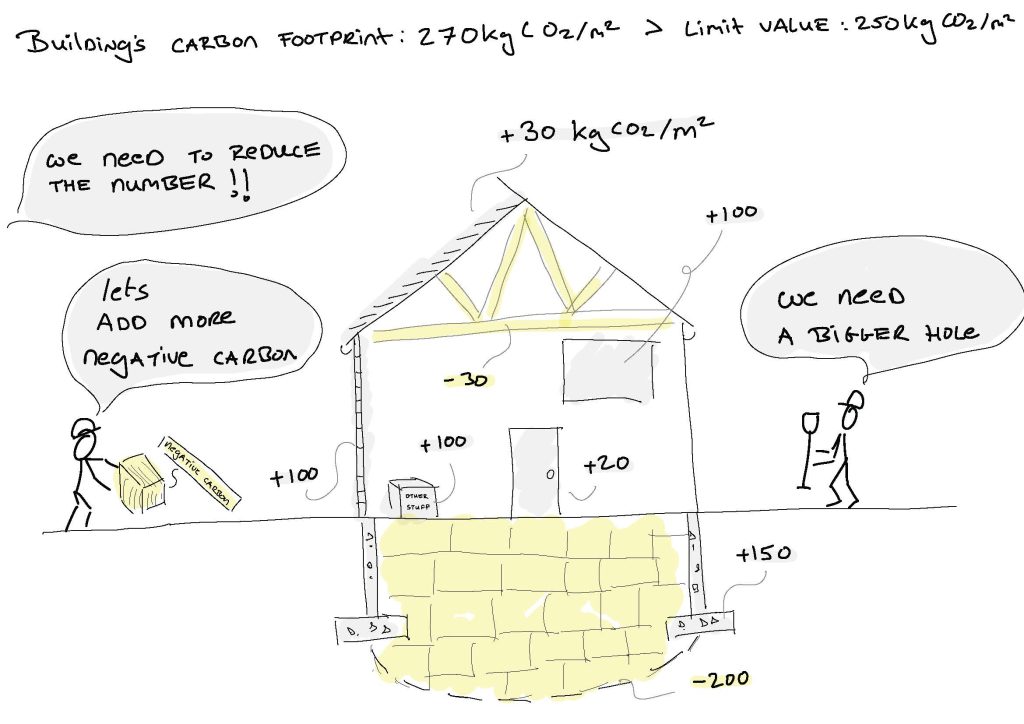
Figure 4. Conceptualising a scenario where limit values are set using A1-A5 (or A-D) LCA modules including biogenic carbon.
Concluding thoughts
In summary the three warning signs highlight how the shift from voluntary carbon calculation towards mandatory declaration requires greater industry-wide competence. To get you moving up this competency curve remember that:
The maths may be simple, but the problem is not. So, try to find benchmarks to compare your findings to. The mitigation impacts are global which means scrutiny is needed by consultants and researchers. And finally, don’t underestimate the complexity of materials.
Richard Feynman: “The first principle is that you must not fool yourself—and you are the easiest person to fool”
Notes:
- European Union, Energy Performance of Buildings Directive, EU/2024/1275.
- Daniel Kahneman, Thinking, Fast and Slow (New York: Farrar, Straus and Giroux, 2011)
- Royal Insituition of Chartered Surveyours, Whole Life Carbon Assessment for the Built 4 Environment, 2nd edn (Global, September 2023), Version 3(August 2024), effective from 1 July 2024.
- Ed Conway, Material World:The Six Raw Materials That Shape Modern Civilization (New York: Knopf, 2023)
- Stena Stal AB, Re-used Post Consumer Steel Beams and Structural Hollow Sections for Load Bearing Structures, EPD Registration Number: EPD-IES-0007617:002 (2024), available at http://environdec.com/library/epd7617 (accessed 3 March 2026).
- JSW Steel Limited, Finished Long Products (Steel), EPD Registration Number: EPD-IES-0004326:001 (2021), available at https://environdec.com/library/epd4326 (accessed 3 March 2026).
This article was originally published in Architecture Ireland March/April 2026 Issue 346.