Dr. Richard O’Hegarty
‘The greenest building is … one that is already built’ wrote Carl Elefante, ex-president of the American Institute of Architects, in 2007.
A phrase which is today so frequently cited with equally dogmatic language that one might assume there exists a compelling evidence-base behind the phrase. The phrase was not, however, a scientific conclusion, it was a provocation. A welcome one.
Carl’s nine-worder provokes us to consider something greener than the shiny low-energy certification hanging on our newly constructed walls, or the solar array covering our recently laid roof, something ‘that is already built’. He was referring to the significant, and at the time of writing, largely unquantified embodied carbon emissions in the materials of our buildings. Suggesting that if we save a building which already exists, we won’t need to build a new one, and therefore we will be emitting less carbon.
At a very high level, saving buildings by repurposing old ones seems like a no-brainer, but in order to ensure this message reaches those who make decisions, we need a greater understanding of what embodied carbon is and greater evidence of its significance.
Understanding embodied carbon
Understanding starts with language, and the abstract nature of the term ‘embodied carbon’ is worth thinking about for a moment. When we detach ourselves from the built environment lexicon and interrogate the term in its literal sense, it makes us think of a building as something which stores carbon, almost as if the carbon is there, physically, in the materials [2].
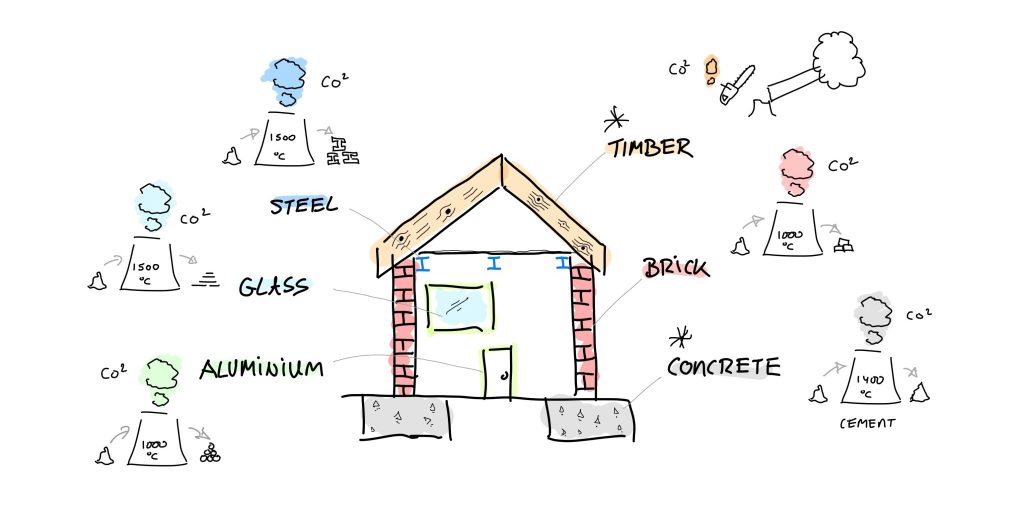
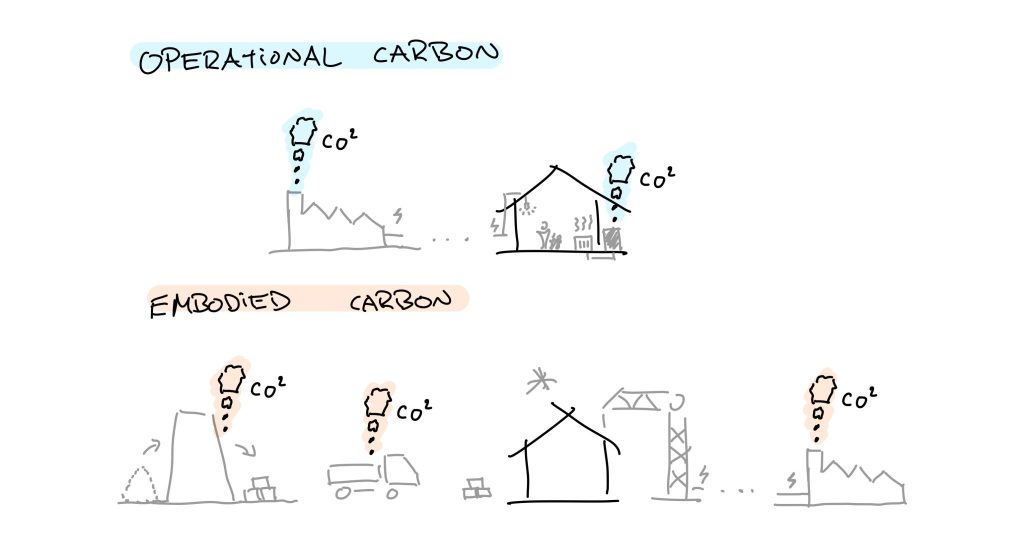
That, however, is not what embodied carbon is referring to. It is referring to the carbon emitted during the process of making a building, all the way from raw material extraction, right through to demolition. The materials do not physically embody carbon dioxide, they embody the responsibility of the carbon emitted further up the supply chain. The physical materials are therefore accountable for those emissions.
Steel, concrete, glass, aluminium, timber and brick account for almost all emissions embodied in an average Irish building[1] and all require some form of energy-intensive processing to convert their raw ingredients into useful building materials. Concrete and timber are slightly different to the other materials in that they do physically ‘store’ carbon, albeit in fundamentally different ways. Concrete, for example, sequesters carbon dioxide from the atmosphere over time through a chemical process known as carbonation. Timber, on the other hand, does not sequester carbon dioxide during its product lifetime, it instead ‘stores’ carbon dioxide which was previously sequestered when growing in the forest in an entirely separate chemical process called photosynthesis.
So while the term embodied carbon does not refer to physically stored carbon dioxide, some of our buildings possess the ability to both sequester and store carbon. That stored carbon dioxide is, however, only a fraction of the total carbon emitted during the processing of those materials.
Measuring embodied carbon
Understanding embodied carbon is only the first step. Ensuring embodied carbon is taken seriously requires evidence, and this evidence needs to be obtained using measurement. If we don’t know how to quantify the emissions embodied in our built environment it will be difficult to encourage policy reform.
To measure the emissions associated with buildings (and infrastructure) we use a carbon accounting exercise called life cycle analysis. A method which can capture the whole life carbon emissions of a building.
At a building’s most basic level this includes two categories of carbon emissions: (1) operational carbon and (2) embodied carbon. While embodied carbon includes those emissions that occur during the production, transportation, construction, and demolition phases of a building’s life, operational carbon emissions occur when fuel is burned onsite to generate heat, or offsite in power plants to generate the electricity we use.
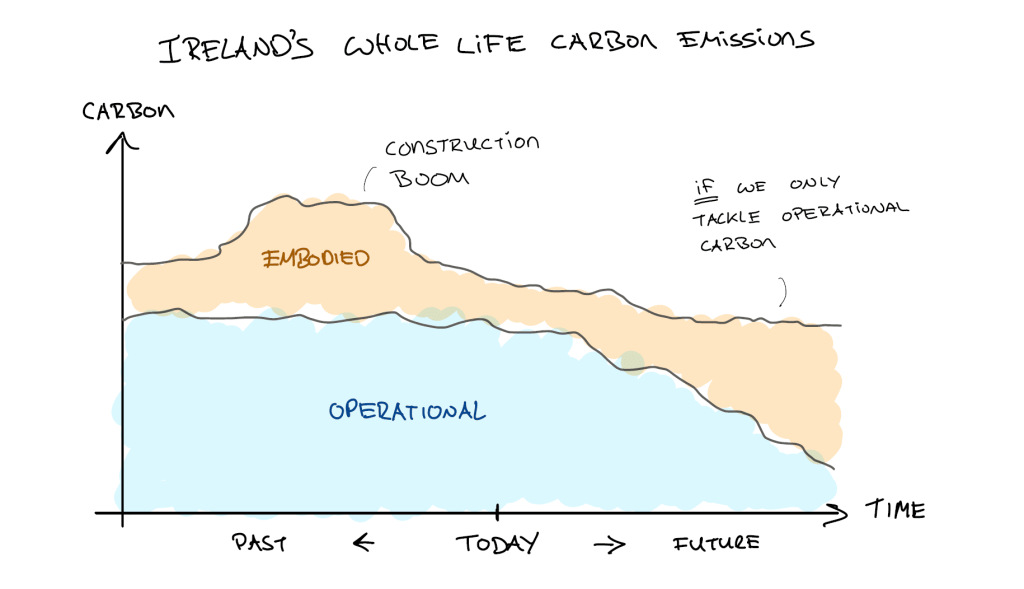
The pendulum is swinging from operational towards embodied – why?
To date, operational carbon emissions have attracted the majority of policy and public focus, and rightly so. Operational carbon still accounts for more than two thirds of our built environment’s whole life carbon emissions, and unprecedented changes are required to reduce this portion of carbon emissions.
But there is a key difference. The technology and regulatory framework required to decarbonise our operational carbon exists while the opposite is true for embodied carbon. Embodied carbon is only recently being discussed at policy level and the technology is in a much earlier stage of development.
Reducing the embodied carbon of our built environment requires both technological and design solutions as well as the appropriate regulatory framework to push current solutions into the market and to incentivise the development of new ones.
Policy
Most current climate action plans, however, fail to address embodied carbon appropriately. They partly address emissions embodied in the material produced in that country (by capping, for example, industry emissions), but they do not account for the emissions associated with imported materials produced abroad. Left unaddressed, current climate targets might have the undesired effect of reducing emissions in our own carbon balance sheets while potentially increasing the global share of emissions by incentivising the import of materials with greater embodied carbon.
At a European level, the progress to mandate the measurement of, and eventual limit to, whole life carbon is slow. The most recent recast of the Energy Performance of Buildings Directive (EPBD), which is the overarching regulatory framework for low-energy buildings in Europe, now mentions embodied carbon and includes the mandatory quantification of a building’s whole life carbon from 2030.
A selection of countries have taken more assertive action. France and Denmark, for example, have demonstrated strong initiative by setting maximum allowable embodied carbon limits for new buildings [3].
Technology and design
Limiting embodied carbon without investing in the research required to decarbonise the significant, and historically overlooked, embodied carbon of our materials is seen by some opposers as a cart-before-the-horse strategy.
There are, however, numerous ways we can reduce embodied carbon. The adaptive reuse of vacant space does not require technological leaps, it instead calls for sensible regulatory changes and creative design solutions to convert those buildings which are ‘already built’ into something we would otherwise be building anew. A number of architectural practices in Ireland, such as RKD, are actively investigating the feasibility of converting older, unused offices into new buildings.
“The adaptive reuse of vacant space does not require technological leaps, it instead calls for sensible regulatory changes and creative design solutions to convert those buildings which are ‘already built’ into something we would otherwise be building anew”
One detailed UK-based case study is the Entopia building in Cambridge. Designed by Architype, this former 1930s telephone exchange has been transformed into the international headquarters for the University of Cambridge’s Institute for Sustainability Leadership. It is an exemplar project, demonstrating how the retrofit and repurposing of an existing building can realise significant savings in embodied carbon, improve energy efficiency, and incorporate principles of the circular economy through selection of material, furniture, fittings, and equipment. Performance was measured through three different certification schemes: BREEAM Outstanding, EnerPHit Classic, and WELL Gold to ensure a holistic approach to long-term building performance. According to the CISL Building Entopia report [4], which is a post occupancy review and case study analysis conducted by the University of Cambridge Institute for Sustainability Leadership: ‘The capital cost of Entopia is estimated to be eight per cent higher than a traditional fit-out, but this is expected to be recovered within five to eight years through lower requirements for operational energy’.
By reusing much of the existing building, the result of the whole-life carbon analysis is 409kgCO2e/m² which includes in-use and end of life carbon, over one-hundred years. To put this achievement in perspective, when comparing this to the RIAI 2030 Climate Challenge, it is well under the embodied carbon target for 2030 of <750kgCO2e/m² (life-cycle embodied carbon). There is also 62,332kg of CO2e avoided in construction materials and 21,000kg of CO2e saved through reclaimed materials such as the PV rooftop canopy, lighting, furniture, fixtures, and equipment. This demonstrates what can be achieved when taking a retrofit approach to building design.
Apart from adaptive reuse, using more sustainable locally-sourced timber, where timber is appropriate, is another solution. The processing of timber is significantly less carbon intensive than that of other material and it is suitable for the urbanisation of some developing/emerging countries [5]. Using timber alone, however, won’t achieve carbon neutrality globally and scaling timber should be approached with considerable caution given the negative impact of replacing natural forests with human-managed ones [6]. Decarbonisation solutions for materials like steel [7] and concrete [8] are still crucial. For concrete, this will likely be a combination of scalable cement replacements (e.g. Ecocem’s ACT), innovative manufacturing techniques to enable greater structural efficiency (e.g. the ACORN project) and to some degree, carbon capture, storage, and utilisation (e.g. Leilac project). For steel, an electrically fuelled process already exists, a process which can in theory be powered by 100% renewable energy, but to ensure it can be scaled further, a greater focus on collecting and resourcing high-quality scrap steel is needed. As a start, we first need to measure the embodied carbon of our building designs. Only then will we be able to understand the impact that our design choices make. Using tools such as the Irish Green Building Council’s Carbon Designer or One Click LCA at the early stage of a project, can give quantifiable insights into the effects of building reuse, its size and material choice. When designed within the targets set under the RIAI 2030 Climate Challenge, our buildings can achieve much lower levels of embodied carbon.
What does the future hold?
Understanding is growing and the evidence is building in favour of embodied-carbon-focused policy reform. This expanse in understanding and evidence drives material and construction innovations. It also encourages designers to consider the less-obvious non-monetary value of buildings, which ‘already exist’.
While the built environment has for many decades been an emitter of carbon, perhaps its future can be different, perhaps it can be one where:
- we make the best use of what is already built;
- annual energy consumption is driven to zero through large scale renovation and net positive buildings;
- thermal and electrical storage in buildings are used to balance a 100% renewably powered energy grid;
- the carbon intensity of the materials we use are transformed by innovations;
- And remaining emissions are captured at source of production, transported with zero-carbon modes of transport, and stored in our building materials.
Perhaps the built environment in the future will ‘literally’ embody carbon; carbon captured from other industries and physically stored in our construction materials. Converting our built environment from one of the biggest carbon emitters to a carbon sink. There is still a long way to go before we arrive here and lots of work to be done.
Notes:
- R. O’Hegarty, O. Kinnane, ‘Whole life carbon quantification of the built environment: Case study Ireland’, Building and Environment, no. 226, 2022.
- J.H. Arehart, J. Hart, F. Pomponi, B. D’Amico, ‘Carbon sequestration and storage in the built environment’, Sustainable Production and Consumption. no. 27, 2021, pp. 1047-1063.
- J. Steinmann, M. Rock, X. Le Den, K. Allacker, T. Lutzkendorf, Whole life carbon models for the EU27 to bring down embodied carbon emissions from new buildings. Review of existing national legislative measures, Ramboll, 2022.
- J. Blaylock, P. Courtice, T. Forman, J. French, J. Reynolds, J. Cole, Building Entopia: An inside view of an ultra sustainable retrofit, University of Cambridge, 2022.
- https://www.africanflow.org/africanflow_eng/
- B. Waring, M. Neumann, I.C. Prentice, M. Adams, P. Smith, M. Siegert, ‘Forests and Decarbonization – Roles of Natural and Planted Forests’, Frontiers in Forests and Global Change, no. 3, 2020, https://www.frontiersin.org/articles/10.3389/ffgc.2020.00058 (accessed 9 May 2023).
- C. Hoffman, M. Van Hoey, B. Zeumer, Decarbonization challenge for steel – Hydrogen as a solution in Europe, McKinsey, 2020.
- R. O’Hegarty, Concrete: Its future in a zero emissions world, Engineers Ireland, 2022, https://www.engineersireland.ie/Covid-19-information-base/concrete-its-future-in-a-zero-emissions-world (accessed 9 May 2023).
This article was originally published in Architecture Ireland May/June 2023 Issue 329.